
Cognivue Spotlight

Alliance Personalized Health Care • July 29, 2024

Introducing a new tool we have added to our clinic, filling a gap in the screening for early cognitive deficits … dementia. For an overview of the full screening process, please see our blog titled Neurocognitive Screening.

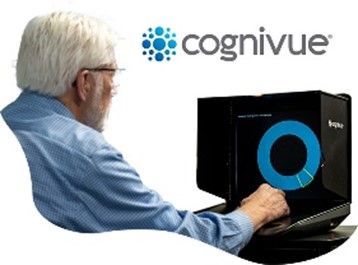
An individual using a Cognivue cognitive screening device, interacting with a circular blue graphic on a screen.

It is challenging to make a diagnosis of dementia in the earliest stages. For some forms, there are specific findings that can lead toward early diagnosis, and some of these are visual findings.


Whereas there are a few diagnostic markers available once a problem has been identified, such as p-tau 217, Beta amyloid, ApoE gene markers, and MRI, they are basically “late to the game”. It’s EARLY SCREENING that is needed.


Typical screening involves a paper based test that misses a significant component … visuospatial, and how that is integrated into what we call executive function. It is known that visuospatial tracking and visual memory correlate fairly well with early disease onset before some of the other things become apparent. It is the visuospatial screening that has been difficult to do in a primary care setting, but finally there are ways to get that done … one of those is via the machine called Cognivue.


(The next few paragraphs get a bit technical. It’s always hard to know who wants to know how much detail. But, forewarned …)


The machine tests what we call visuospatial function. Broadly defined, visuospatial function is the ability to specify the parts and overall configuration of a percept (a mental concept that is developed as a consequence of the process of perception), appreciate its position in space, integrate a coherent spatial framework, and perform mental operations on spatial concepts. Visuospatial function is commonly conceptualized in three components: visual perception, visual construction, and visual memory.

  • Visual perception involves light perception, contrast sensitivity, stimulus orientation, visual acuity, detection of color and motion, and processes mediated primarily by the occipital cortices.
  • Visual construction involves multiple areas of the brain putting things together (the parietal, temporal, and frontal cortices).
  • Visual memory consists of two main components: recall of visual information and topographical memory.


Visuospatial dysfunction is among the earliest manifestations in some dementias, eventually affecting >20% of those patients. One study showed disabling visuospatial disorientation in more than one-third of dementia patients, while almost half of patients complained of visuospatial problems when questioned directly. Patients may describe impaired discrimination of form, colors and contrast, motion detection, as well as disturbances of higher order functions such as reading, visuospatial orientation, and visual search strategies.


You can see how complicated the entire process is, and traditional testing does not engage this aspect. That is why we are so pleased to have an additional tool. Now that we have reviewed the what and the why, let’s discuss the machine itself.


It’s called Cognivue and it is in our office. The device is a self-administered, digital cognitive assessment that standardizes the patient’s experience and removes the bias that can exist with traditional testing methods. The technology collects over 130,000 data points and is highly sensitive to each individual patient. It uses something called adaptive psychophysics, creating a unique patient experience customized to each patient’s individual visual and motor skills. It has been validated against other recognized gold-standard cognitive assessment tools, while providing an experience customized to each patient. The custom experience is important to what we do at Alliance, and the self-administered computerized process fits seamlessly into the clinic workflow. You may note that rather than using a keyboard, the entire test is done via what they call a CogniWheel. It is a simple, intuitive, and easy-to-maneuver wheel.


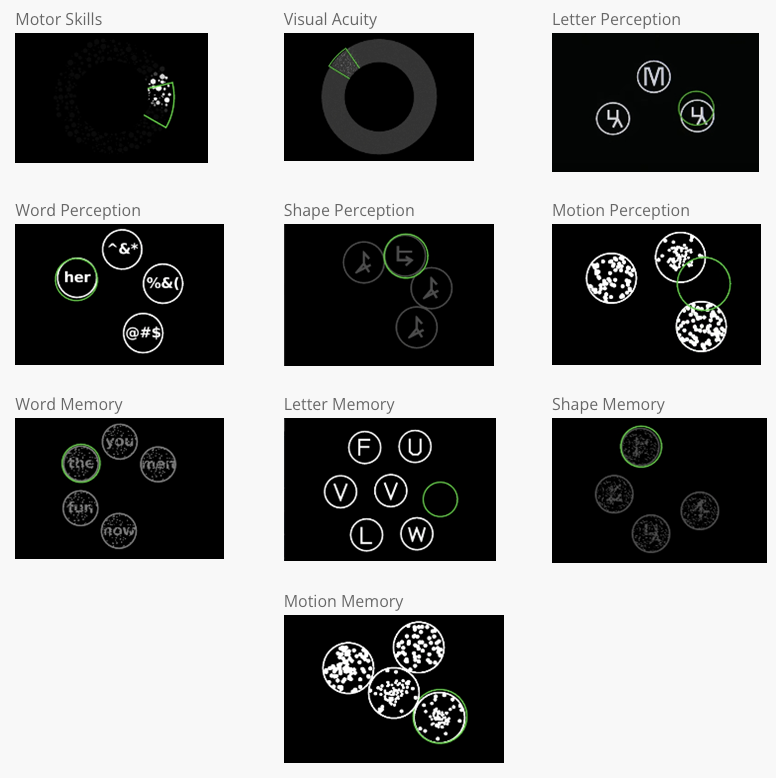
The test process itself takes the patient through a series of exercises to assess the domains of Visiospatial: Memory, Executive Function/Attention, and Discrimination, as well as two speed performance parameters. The computer screen with which the patient interacts will look a lot like the following (notice how the activity presented changes depending on the specific aspect being tested):

A grid of ten cognitive task icons with dark backgrounds, white text, and green progress indicators for performance tracking.

The Cogniwheel is the control that allows the user to maneuver a highlighted area to select the response they wish to enter. The results are calculated via the computer, taking into account the patient error rates, reproducibility of the errors, and reaction time. Those results are compared with a large data set, placing the patient on a curve of what would be considered normal or outside of the normal range, and generates a score for each section. This is helpful because should a narrow problem be identified, it can be followed by additional investigations and potential referrals to neurology or ophthalmology. Should the test be considered “normal”, then the score is helpful as a marker for repeat screening at a later date (perhaps annually). A decline would also lead to additional investigations and potential referrals.


We then incorporate this information with the remainder of the cognitive screening visit, and merge all of that with what we know about you.


That concludes the overview of one more tool we have available at Alliance. This is perhaps a perfect example of integrating modern technology with your story and our experience … something we continually strive to deliver.

Recent Posts

A stethoscope and a decorative red wire heart lie on a bright blue surface next to a calculator.
By Alliance Personalized Health Care • May 23, 2025
This blog post reviews the personal health journal which includes an inventory of all his/her tests, tabulated tracking of important results, and more!
A healthcare professional adjusting headphones on a patient during a hearing test in a clinical office setting.
By Alliance Personalized Health Care • December 2, 2024
Get your hearing tested with Alliance Personalized Health Care

A wooden cutout of a human head profile on a white wooden background, with a red heart icon inside the brain area.
By Alliance Personalized Health Care • September 6, 2024
Brain health is extremely important. A large part of what we do at Alliance is focused on maintaining and improving brain health. As we age, we all slow down, both physically and mentally, and we want to decrease the decline of both as much as possible. One of the ways we are able to evaluate cognitive changes is by doing lab work, then evaluating that in context with the entire person. We have partnered with Quest Lab and UMethod to provide a test known as RestoreU Method in order to have a more inclusive way of evaluating someone’s cognitive function. This is used in conjunction with the Cognivue test, other labs and possibly imaging, which were described in a previous blog.

Colorful assortment of salmon, avocado, berries, seeds, and vegetables on a gray background
By Alliance Personalized Health Care • August 20, 2024
We venture to say that most patients are familiar with the word cholesterol and have some concept of the importance it plays in cardiovascular health. It is also likely that most people have heard that there is more to it than simply measuring total cholesterol. After all, when was the last time your doctor ordered anything other than a four-way profile of LDL, HDL, Triglycerides, and Total Cholesterol? And for those of you who like math, did you know the formula (roughly) is: HDL + LDL + 0.2(Triglycerides) = Total?

A 3D visualization of multiple rod-shaped bacteria with flagella, depicted in shades of blue.
By Alliance Personalized Healthcare • August 7, 2024
I once heard a microbiologist say that the human is nothing more than a transport medium for the microbiological world. What he is inferring is that though we use our 30 trillion cells to orchestrate physical movement in this world, the 40 trillion microbes that live within us lack that mobility. That’s not a type-o … there are likely more microbes living within the gut than there are human cells for any individual. And it would be too anthropocentric of us to think we should ignore them. Though small in size, they do outnumber us, and what they lack in size they make up for in a complicated world of symbiotic relationships, outright battle for dominance, and production of by-products to improve their own environment which directly affects our gut health and overall sense of well being. Let’s talk about some common maladies for which we should consider the microbiome. There are many who suffer from recurring or constant difficulties involving nausea, pain, change in bowel habits, and food intolerances. So often, an extensive workup finds no severe problem that needs intervention. After that good news, the focus turns to managing symptoms. And that’s where things remain difficult for years, involving medications with side effects and expense. Of course, it’s in vogue to talk about food allergies and to adjust our diet, but why does that matter when it’s not a true allergy? Remember those trillions of microbes? Could they be part of the problem or part of the solution? Turns out, the answer is yes. Not always, but a lot of the time. For what we call functional abdominal pain (anatomically fine, no obvious disease, just doesn’t function smoothly), it can often be from “dysbiosis”, an imbalance in the groups of microbes. We humans function smoother when the various groups of organisms remain in a steady state. When one group outmaneuvers another or migrates location within the gut, it can create dysbiosis and functional abdominal pain. That’s where probiotics get their credibility. But which probiotic (hundreds to choose from) and in which combination? The reason there is so much confusion is that each of us is unique. Imagine that; one size does not fit all.

Two pairs of hands holding a paper cutout of a human head silhouette featuring a pink heart with an EKG line.
By Alliance Personalized Health Care • July 29, 2024
Neurocognition refers to the functional aspects of the brain. That includes receiving proper input from the senses (hearing, vision, touch, smell). It involves the processing of received information. It certainly involves the orchestration of complex movements, emotional interactions with others, and complex thought processing.

Colorful ribbon bows arranged on a pale beige background
By Alliance Personalized Health Care • June 17, 2024
The Big “C." No one likes the word, but if we can’t say it, then we can’t look for it … and finding it early is everything. Let’s talk about Cancer Screenings
A tablet displaying digital health data, stethoscope, blood pressure monitor, and face mask on a medical chart background.
By Alliance Personalized Health Care • June 12, 2024
We would like to discuss body composition analysis, dietary choices, exercise regimens, and the integration of that into the Personalized Health Care Plan.

A colorful assortment of fresh produce including tomatoes, eggs, strawberries, an apple, orange, beans, and grains.
By Alliance Personalized Health Care • June 6, 2024
We are excited to share that we have a dietitian that we work closely with, who is helping our patients achieve their nutrition goals. Lauren comes and sees our patients in our clinic, or if you prefer, you can meet her at her office. We highly recommend reaching out to her to accomplish your goals.

A red heart model sits on a line of white pills arranged to look like an EKG heart rate monitor on a blue background.
By Alliance Personalized Health Care • May 24, 2024
At Alliance, it’s all about having personalized health care.  Part of that personalization frequently involves prescription medications. Knowing the chemistry and genetics of each individual can significantly influence the response to those therapies. At Alliance, we are literally aiming to hit the mark as close as possible without undue side effects. Science is finally catching up to modern prescription management and we are pleased to offer our patients pharmacogenomic testing.
Show More